
Marine environments accelerate zipper failure faster than most industries realize.
Salt spray corrodes metal components. UV radiation degrades polymer chains. Moisture retention creates electrochemical corrosion at contact points. Unlike terrestrial applications—where a zipper may endure decades of moderate use—marine zippers face simultaneous assaults: saltwater oxidation, thermal cycling from extreme temperature swings, mechanical loading from swollen or shrinking canvas, and constant moisture saturation.
Standard heavy-duty zippers designed for industrial wear often fail within one to two seasons of marine exposure. The term heavy-duty describes load capacity and stitch density—not environmental resilience. A zipper rated for thousands of opening cycles under laboratory conditions performs very differently when exposed to saltwater fog, direct UV radiation, and temperature fluctuations ranging from freezing winters to tropical heat.
The failure modes are consistent. Teeth separate. Sliders corrode in place. Tapes delaminate. Coil elements absorb moisture and accelerate material degradation.
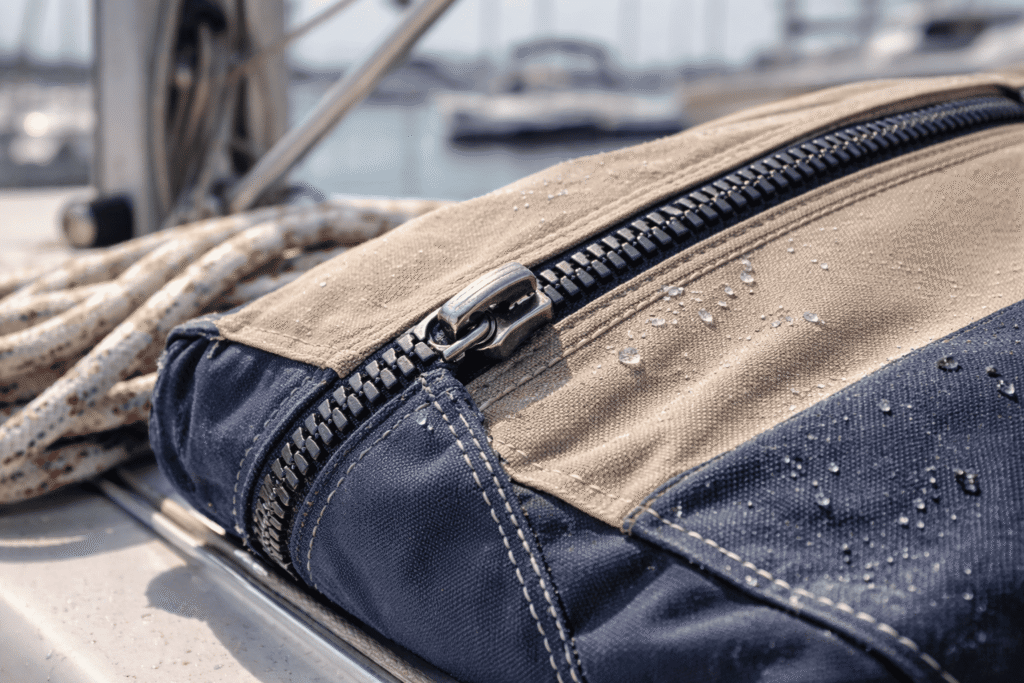
Marine-grade engineering addresses these failures systematically. Molded plastic teeth resist saltwater corrosion inherently. Metal components are specified in corrosion-resistant alloys. Zipper tapes incorporate UV inhibitors and moisture barriers. Slider mechanisms are designed with wider tolerances to accommodate tape swelling caused by hydration—factors often overlooked in standard zipper testing standards.
Custom specifications matter because stock catalogs optimize for general industrial duty—not the chemistry, physics, and exposure patterns of marine service. This distinction is especially critical for marine fabricators operating in salt, sun, and moisture-heavy environments.
1. Boat Covers & Mooring Covers
Boat covers remain outdoors for months or years at a time. They absorb salt spray, rain, dew, and humid air while enduring direct, high-intensity sunlight. The fabric beneath the zipper swells when hydrated and contracts as it dries, creating constant dimensional movement.
Wind loading introduces repetitive mechanical cycling even when the zipper is never operated. Over time, canvas and vinyl materials shrink, placing sustained tensile stress on zipper teeth and tape attachment points.
Unlike garments or bags, boat cover zippers exist in a semi-permanent state of moisture saturation. Salt deposits accumulate within the zipper mechanism, creating corrosion pathways that are rarely flushed or dried—an issue commonly addressed through preventing corrosion for marine zipper care.
In marine environments, stagnation—not motion—is the enemy.
Zipper Performance Requirements
#10 molded plastic zippers dominate this application because they deliver load-bearing capacity without corrosion risk. Molded acetal teeth resist electrochemical attack and shed salt deposits more effectively than coil designs.
Stainless steel sliders are essential. Galvanized or nickel-plated sliders commonly seize after prolonged salt exposure.
Zipper tape must resist both UV degradation and mildew growth. Polyester or specially coated nylon tapes outperform standard upholstery tapes, while PU-coated tape adds a moisture barrier behind the teeth—consistent with modern zipper coatings and finishes.
Separating configurations are standard, allowing large fabric assemblies to be removed or installed without stressing the zipper at termination points.
Slider tolerances must accommodate seasonal tape swelling. Larger tooth profiles (#10 or #12) resist debris accumulation and binding far better than smaller constructions, as outlined in common zipper gauge sizes.
Why Custom Specifications Matter
Stock boat cover zippers fail because they are not designed for permanent moisture exposure. Coil zippers, in particular, absorb water through the sewn cord, creating a structural weak point at the stitch interface under cyclic load and UV exposure.
Custom specifications eliminate this failure mode by selecting molded tooth construction from the outset. Stainless hardware is specified intentionally, not substituted. Tape backings incorporate UV stabilizers and mildew inhibitors absent from commodity stock.
Slider geometry can be adjusted to tolerate tape expansion without binding—an accommodation that stock designs rarely provide.
The result is not a marginal improvement, but a meaningful extension of service life.
2. Bimini Tops & Marine Canvas Enclosures
Bimini tops combine environmental exposure with constant mechanical movement.
Application Stressors
These structures flex continuously in wind and vessel motion. Zippers experience load even when untouched. Water pools along zipper seams, creating stagnant moisture zones that accelerate corrosion.
Curved geometry introduces uneven load distribution along the zipper path. Temperature changes cause canvas and zipper tape to expand and contract at different rates, compounding stress at attachment points.
Zipper Performance Requirements
Both coil and molded tooth zippers can perform well, depending on geometry. Molded plastic zippers (#10 or #12) excel in straight runs under heavy UV exposure, while coil zippers (#5 or #8) perform better on curved panels—a distinction explored further in coil vs molded zippers.
Direct UV exposure is the primary enemy of coil zippers. Fabric flaps dramatically extend service life by shielding the nylon monofilament from degradation, consistent with findings on how UV resistance impacts outdoor zipper lifespan.
Two-way configurations are often used on large enclosures to reduce operating force and improve access.
Why Custom Specifications Matter
Stock bimini zippers rarely account for curvature, fabric weight, or movement patterns. Custom specification allows evaluation on actual canvas samples to ensure tape integrity and smooth slider travel.
Custom pull designs enable control-line operation from the helm. Tape color matching improves inspection visibility. Slider modifications can integrate D-rings or lanyard attachment points, reducing secondary hardware requirements.
3. Cockpit & Cabin Enclosures
Cockpit enclosures are high-use closures that function as water barriers.
Application Stressors
These zippers open and close dozens of times per day. Salt deposits accumulate daily on slider mechanisms. Enclosed spaces trap moisture, while condensation accelerates corrosion behind the zipper.
During seasonal storage, zippers often remain saturated with stagnant moisture—an ideal corrosion environment.
Zipper Performance Requirements
#10 or #12 molded plastic zippers are standard. Molded teeth shed salt and resist moisture retention far better than coil designs.
Stainless steel sliders are mandatory. Brass and nickel-plated alternatives commonly seize within a single season.
Bridge-top sliders prevent pull-off failures under aggressive operation. Two-way designs reduce operating force on large enclosures.
Why Custom Specifications Matter
Complex enclosure geometry requires pattern-specific evaluation. Custom tape reinforcement at corners prevents separation under concentrated load.
Custom pull designs improve operation with gloves and cold hands. Control-line integration allows operation without leaving the helm—an operational safety advantage.
4. Sail Bags & Rigging Covers
Sail bags experience abrasion, UV exposure, and load under tension.
Application Stressors
These bags are dragged across decks, rubbed against hardware, and stored in confined spaces. Zippers operate under tension, not relaxed alignment.
UV exposure is cumulative and severe, especially on mainsail covers that remain deployed for months.
Zipper Performance Requirements
#12 molded plastic zippers dominate large sail covers due to abrasion resistance and UV stability. Larger tooth profiles resist debris accumulation.
Coil zippers may be used on smaller rigging covers where flexibility is required, but only with PU-coated tape and UV shielding commonly used in marine outdoor zipper applications.
Why Custom Specifications Matter
Custom lengths eliminate unnecessary bulk. Control-line pull tabs reduce wear and salt transfer. Reinforced tape backing at contact points extends service life under repeated abrasion.
5. Marine Upholstery Cushions
Upholstery zippers fail quietly in marine environments.
Application Stressors
Cushions remain damp for extended periods. Moisture becomes trapped inside covers, creating ideal mildew and corrosion conditions. Thermal cycling stresses tape attachment points.
Zipper Performance Requirements
#5 or #8 molded plastic zippers balance durability and appearance. Polyester or treated nylon tape resists mildew.
Closed-end designs with bridge-top sliders prevent pull-off failures during removal.
Why Custom Specifications Matter
Custom color matching, mildew-resistant tape treatments, and optimized slider geometry improve longevity and usability in tight cabin spaces.
6. Marine Storage Bags & Deck Organizers
Deck bags protect valuable equipment in exposed locations.
Application Stressors
Continuous salt spray, trapped moisture, sand intrusion, and steady mechanical loading define this application.
Zipper Performance Requirements
#8 or #10 molded plastic zippers resist debris and corrosion. Stainless sliders are essential.
Two-way or separating configurations improve access on crowded decks.
Why Custom Specifications Matter
Custom reinforcement distributes the load. Slider modifications enable one-handed operation. UV-inhibited tape prevents internal mildew growth.
7. Immersion Suits & Cold-Water Survival Gear
Immersion suits are safety-critical systems.
Application Stressors
Zippers operate during full submersion in freezing water. Dexterity is compromised. Failure results in thermal loss and hypothermia.
Zipper Performance Requirements
Cold-water-rated molded plastic systems are mandatory. Extended runs require custom lengths. Waterproof tape sealing and anti-reverse sliders prevent ingress under pressure, consistent with proven cold-weather zipper performance.
Wide sliders and extended pull tabs enable gloved operation.
Why Custom Specifications Matter
Custom length, slider geometry, anti-reverse mechanisms, and reinforced tape are operational requirements—not optimizations. Every component is validated through immersion testing.
8. Dive Bags & Marine Safety Equipment
Dive bags experience wet-dry corrosion cycles.
Application Stressors
Repeated saturation and drying accelerate oxidation. Bags are dropped, compressed, and handled roughly.
Zipper Performance Requirements
#8 or #10 molded plastic zippers with stainless hardware provide reliable closure. Two-way designs improve access to bulky equipment.
Why Custom Specifications Matter
Custom attachment points, textured pull tabs, and differentiated zipper specs for mesh panels improve durability and usability.
9. Jet Ski & Personal Watercraft Covers
PWC covers experience vibration-induced fatigue.
Application Stressors
Trailering introduces high-frequency vibration. Freshwater rinsing accelerates electrochemical corrosion cycles.
Zipper Performance Requirements
#10 molded plastic zippers with reinforced attachment points resist vibration and frequent cycling.
Why Custom Specifications Matter
Custom lengths align with model-specific geometry. Locking or friction-enhanced sliders prevent vibration-induced opening.
10. Custom Marine Fabrication Projects
Custom marine builds expose the limits of stock zippers.
Application Stressors
Unique geometry, extended service life expectations, and specialized exposure conditions define this category.
Zipper Performance Requirements
Specifications are derived from the application, not a catalog. Material testing and prototype validation are standard.
Why Custom Specifications Matter
Custom length, material selection, slider design, tape composition, and attachment methodology determine long-term performance. Engineering partnership—not commodity sourcing—drives success.
For marine fabricators and manufacturers evaluating zipper performance at the specification level, working with a manufacturer that understands marine corrosion, UV degradation, and custom fabrication constraints is essential. Lenzip Manufacturing supports marine applications with made-to-order zipper construction engineered around real-world exposure conditions—not catalog assumptions.
Request a Quote today!
Additional Resources
Conclusion
“Heavy-duty” describes mechanical capacity, not environmental resilience.
Marine-grade zippers succeed because they address corrosion, UV degradation, moisture retention, and mechanical stress through material science and manufacturing precision. Molded plastic teeth resist oxidation in saltwater environments. Stainless hardware prevents electrochemical failure under prolonged exposure. Moisture barriers reduce mildew growth and tape delamination. Slider tolerances accommodate fabric swelling caused by hydration and thermal cycling.
Selecting zipper suppliers for marine applications requires evaluating technical competence—not catalog breadth. Fabricators and manufacturers who prioritize materials science, corrosion behavior, and application-specific specifications consistently achieve superior field performance and longer service life.
Marine environments do not reward generalization.
They reward engineering.